Stablecoins vs. Legacy Rails: Cost-Benefit Analysis for Machine Commerce
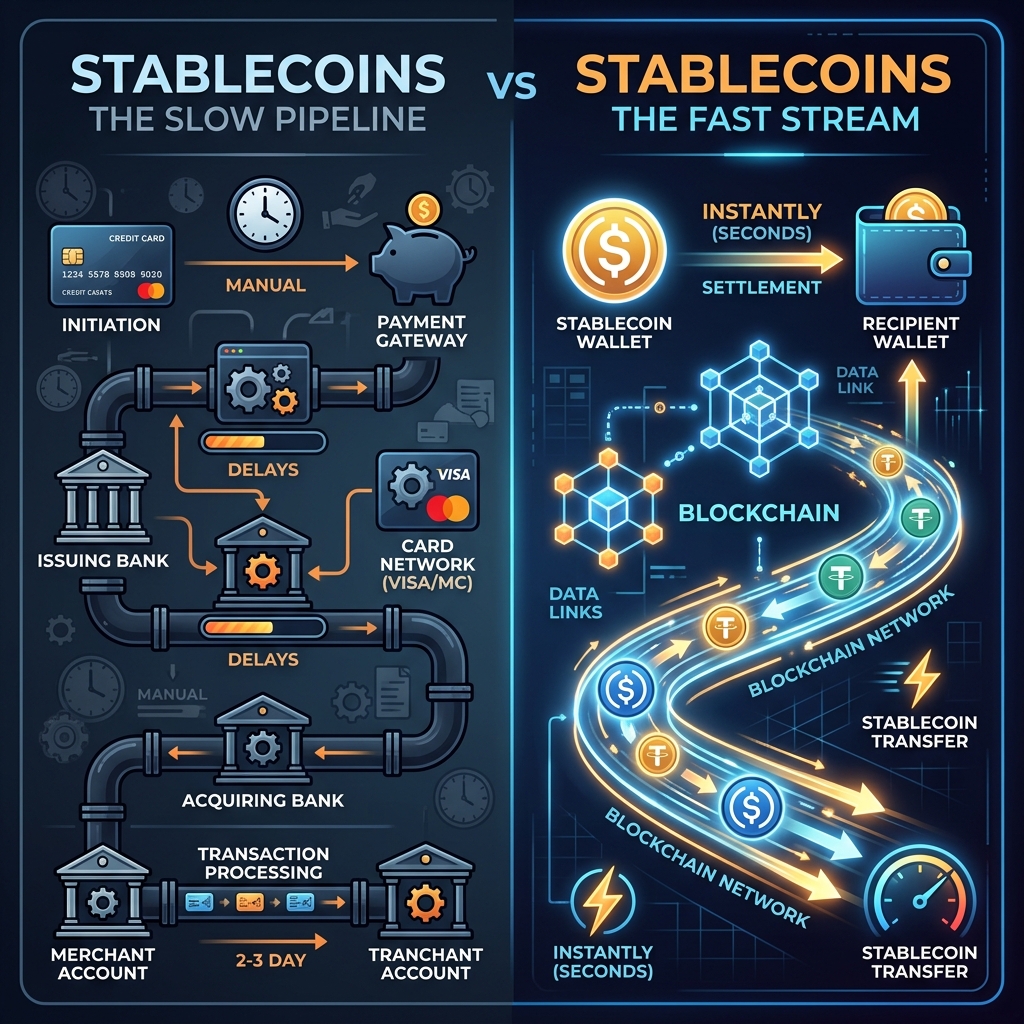
The Microtransaction Dilemma in High-Frequency AI Workflows
As software agents begin operating at scale, the frequency of transactions increases exponentially. In human commerce, a user might execute 2 to 5 transactions per day. An autonomous AI agent, however, may call 1,000 language model instances, query 500 search endpoints, and request 100 database transactions every single hour.
For these high-frequency workflows, traditional banking rails are economically unviable. In this research paper, we provide a detailed cost-benefit analysis comparing legacy credit networks, ACH bank wires, and L2 stablecoin streams.
---
Quantitative Comparison: Financial & Operational Metrics
Below is an operational comparison table detailing the cost, speed, and capabilities of the leading payment networks:
| Metric | Credit Card Networks (Visa/MC) | ACH Bank Transfer | L2 Stablecoin Streams (BotPay) |
|---|---|---|---|
| Average Flat Fee | 0.30 | 0.25 - 1.50 | 0.00 (Gas-Abstracted) |
| Percentage Surcharge | 1.5% - 3.5% | 0.0% | 0.0% |
| Minimum Viable Transaction | 1.00 | 5.00 | 0.0001 (Micropayment) |
| Settlement Time | 2 - 3 Days (Cleared) | 3 - 5 Business Days | <1 Second (Sub-second) |
| Refunds & Chargebacks | High risk (Fraud/ Disputes) | Moderate risk | Zero risk (Final settlement) |
| Programmability | Weak (Restricted APIs) | None (Manual files) | Turing-Complete (Smart Contracts) |
| Auth Loop | Manual Human (3DS) | Manual Human (Micro-deposits) | Cryptographic Key (Non-Interactive) |
---
Economic Analysis of Fee Overheads
To illustrate the cost differences, let's analyze a typical AI agent workflow that executes 10,000 API calls per day, with each call valued at 0.01:
- Scenario A: Credit Card Payment per Call
- * Total Transaction Value: 100.00
- * Visa/MC Fees (0.30 flat + 2.9% per call):
- \text{Total Fees} = 10,000 \times (\0.30 + \0.00029) = \3,002.90
- * Result: Devastating loss. The transaction fees are 30 times higher than the value of the services purchased.
- Scenario B: Pre-paid API Accounts (ACH)
- * The developer deposits 100.00 upfront into 10 different API vendor portals to avoid individual transaction fees.
- * Result: Pre-paid credits avoid microtransaction fees, but they fragment liquidity, trap capital across multiple platforms, and require manual human setup for each vendor.
- Scenario C: BotPay L2 Streaming
- * The agent establishes a unified payment stream. The streams run in real-time, accumulating off-chain.
- * At the end of the billing cycle, the netting engine aggregates the 10,000 transactions and settles them in a single consolidated transaction.
- * Result: 0.05 total settlement cost. Zero capital fragmentation, zero transaction overhead, and instant liquidity.
---
Operational Advantages of L2 Stablecoin Streams
Beyond direct cost savings, stablecoin streams offer significant operational benefits for machine-to-machine commerce:
1. Immutable SLA Enforcement & Escrow With BotPay, payments are tied directly to Service Level Agreements (SLAs). Funds are locked in escrow and streamed only as long as the provider bot meets its performance metrics. If the provider bot goes offline or fails an SLA check, the client bot automatically halts the stream, preventing payment for failed jobs.
2. Automatic Fraud Reduction Unlike credit card networks, where chargebacks can occur up to 180 days post-transaction, on-chain stablecoin settlements are instant and final. This eliminates chargeback fraud risk, allowing developers to deploy autonomous agents without maintaining large cash reserves.
3. Native Programmability Because stablecoin transactions are powered by smart contracts, you can build complex commercial logic directly into the payment flow: * **Nested Streams**: A lead bot receives a stream of 1 USDC/min and automatically splits it, streaming 0.6 USDC/min to a translation bot and 0.4 USDC/min to a data storage bot. * **Reputation-based Pricing**: The protocol automatically discounts pricing for provider bots with high reputation scores (ERC-8004).
---
Conclusion
For machine-to-machine commerce, stablecoin streaming protocols like BotPay are not just an alternative payment method—they are a core requirement. By eliminating flat-fee overheads and manual authentication loops, BotPay provides the financial rails needed to scale the autonomous agent economy.
Ready to integrate programmable streaming payments into your stack? Read our API Docs or test your integration in the API Playground.
Empower AI Agents with Stablecoin Escrows
Take BotPay for a test drive. Open our sandbox sandbox simulator to register a mock agent, fund its developer wallet with testnet USDC, and simulate high-frequency API payment flows under a minute.